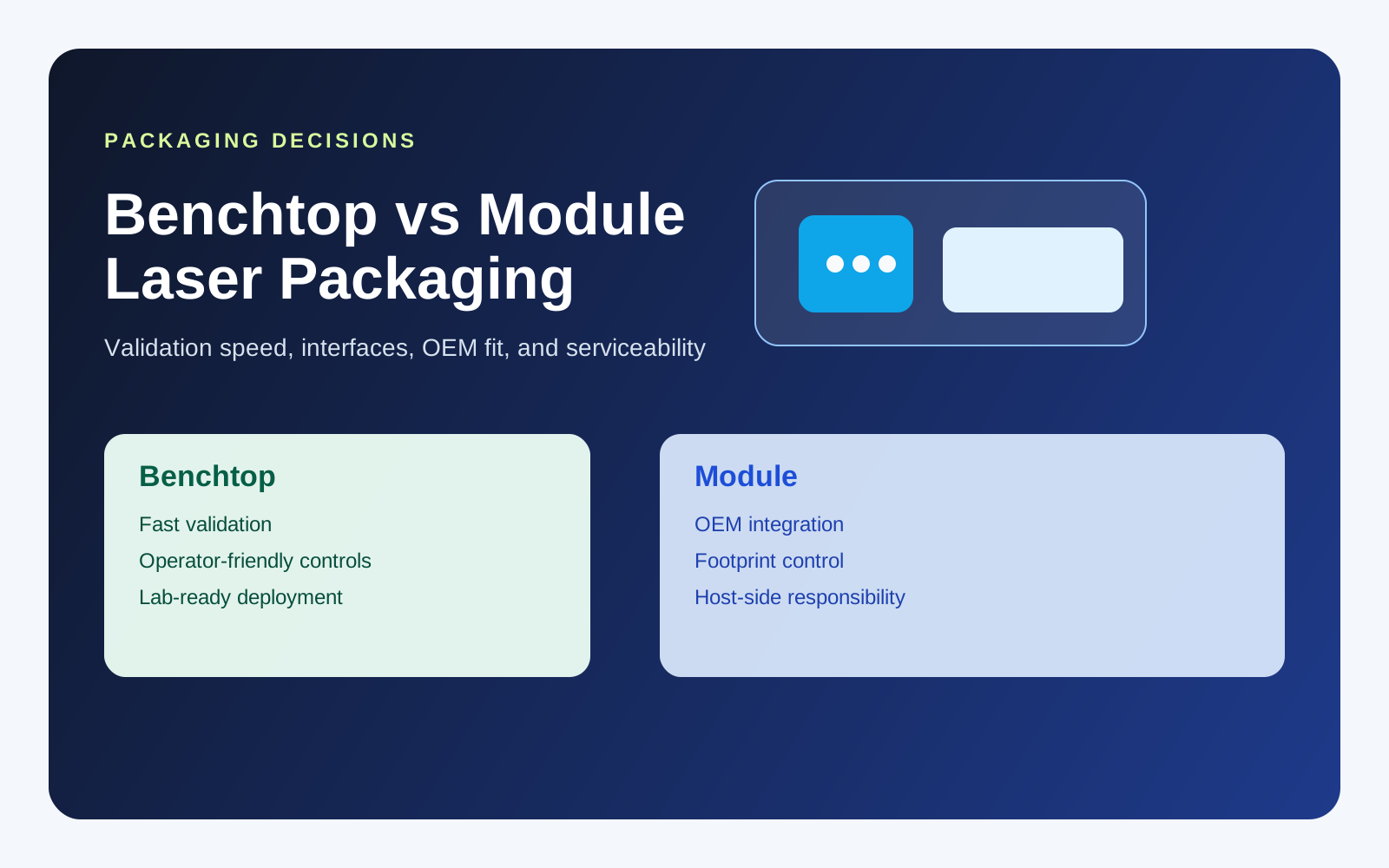
Packaging format changes the whole evaluation workflow
Two laser products can share wavelength and power characteristics while behaving very differently in an engineering program because the package format changes installation, controls, safety handling, and test speed.
That is why benchtop versus module should be treated as an early decision rather than a final cosmetic choice.
Benchtop systems are usually the fastest route to validation
Benchtop laser systems are a good fit when the immediate priority is evaluation.
They are often preferable when:
A lab needs to begin testing quickly
Multiple users will operate the source
The project is still comparing parameter windows
A standalone user interface is helpful
Serviceability and access matter more than compactness
Because the control and packaging layers are already organized for direct use, benchtop units often shorten the time between procurement and first data collection.
Module systems are usually the better choice for product integration
Module formats are often chosen when the laser is only one subsystem within a larger machine. They are especially valuable when the final product needs tighter control over footprint, internal wiring, thermal design, and system-level packaging.
Modules are commonly the right direction when:
The laser will be embedded into an OEM platform
A host controller already exists
Mechanical volume is constrained
The team wants tighter control of electrical and software integration
The project will scale into repeatable manufacturing
This does not always make modules cheaper in practice, because integration effort can move from the supplier to the customer team.
Think about interfaces before finalizing the format
One of the most common integration mistakes is focusing only on optical parameters while leaving control assumptions undefined.
Before choosing the package, confirm:
How the laser will be enabled and monitored
Whether RS232 or another control path is required
Which alarms, interlocks, or status signals matter
Who owns system startup and shutdown sequencing
Benchtop products often simplify this layer. Modules usually offer more flexibility but place more responsibility on the integrator.
Thermal and service implications are different
Package format also affects maintenance and support planning.
For evaluation-heavy environments, benchtop systems are easier to swap, inspect, and support remotely. For OEM programs, modules may align better with production architecture, but troubleshooting can become more dependent on the host system around them.
Engineering teams should ask a simple question: are we optimizing for immediate usability or final system fit?
Procurement recommendation
If the project is in early validation, choose benchtop unless there is a strong mechanical reason not to.
If the system architecture is already stable and the laser is clearly headed into an embedded product, choose a module and define the host-side responsibilities early.
That single distinction prevents a large number of avoidable integration delays later in the project.