Insights & Guides
Laser Application Notes & System Insights
Configuration guidance, application references, and procurement-focused articles for wavelength-sensitive and parameter-heavy laser systems.
How ASE Light Sources Are Used in Fiber Optic Gyroscopes
A practical guide to choosing ASE sources for fiber optic gyroscopes, covering wavelength, bandwidth definition, polarization, PSD, RIN, detector power, fiber, and package trade-offs.
Laser Specification Sheet Explained: 15 Parameters Buyers Should Understand
A practical guide to the 15 laser specifications that determine whether a source will work in your measurement, from wavelength and linewidth to power definition, fiber output, stability, and OEM integration.
What Is Distributed Fiber-Optic Photoacoustic Sensing (DFPS)? Laser Source Requirements for Active Fiber NDT
DFPS turns an optical fiber into an active ultrasonic NDT network instead of a passive listener. Learn how distributed fiber-optic photoacoustic sensing works, and which laser sources drive excitation and interrogation.
C-Band vs L-Band ASE Light Sources for Telecom Component Testing
If your telecom component is designed for the C-band, start with a C-band ASE source. If the DUT is built for the L-band, start with an L-band source. Choose a combined C+L ASE source when one bench must cover both windows, and verify the power density and flatness required across the full span.
How Much Laser Power Do You Actually Need for Optical Testing?
Most optical testing setups need less laser power than buyers first assume. Start with the power required at the detector or device under test, add real path losses and a practical reserve, then choose the smallest source that delivers stable margin without saturation or unnecessary cost.
ITU-T G.681 Explained: A Light Source Selection Guide for Distributed Fiber Optic Sensing Systems
ITU-T G.681 is now in force for distributed fiber optic sensing on terrestrial optical transmission systems. Learn how to choose ASE, tunable, and narrow-linewidth sources for phase-OTDR, BOTDR/BOTDA, and Rayleigh-based DFOS systems.
Fiber-Coupled Laser Buying Guide: When Fiber Delivery Is Better Than Free-Space Alignment
A practical guide to choosing fiber-coupled or free-space laser delivery, with wavelength, power, fiber, connector, package, and RFQ questions to confirm before purchase.
ASE Broadband Light Source vs. Supercontinuum Light Source: Which Broadband Source Should You Choose?
ASE broadband sources vs. supercontinuum lasers compared on spectral coverage, noise, coherence, and cost — with a selection guide for OCT, spectroscopy, fiber sensing, and component testing.
1310 nm vs 1550 nm for Fiber Optic Testing: OTDR and In-Line Testing Guide
1310 nm vs 1550 nm for fiber optic testing: compare OTDR and in-line testing, attenuation, dispersion, power, fiber type, and the right telecom test source.
Single-Mode vs Polarization-Maintaining Fiber Lasers: Which Output Fiber Do You Need?
Single-mode fiber output is the right default for many laser systems, but it is not the right answer when your measurement depends on a stable polarization state. This guide explains when standard SM output is enough, when PM fiber is worth the extra cost and specification work, and what buyers should confirm before requesting a quote.
How to Choose a Broadband Light Source for OCT
The right OCT broadband light source is not chosen by “broadband” alone. Start with the OCT wavelength band, then compare bandwidth definition, usable power spectral density, polarization behavior, fiber interface, and package format before you request a quote.
1064 nm vs 1550 nm Lasers for LiDAR: Performance, Eye Safety, and System Trade-Offs
For LiDAR, 1064 nm is usually the cleaner fit for short-pulse time-of-flight designs, while 1550 nm is often the better direction when eye-safety margin, telecom-band integration, or coherent detection matter more. This guide compares the trade-offs buyers should settle before requesting a quote.
How to Select a Laser for LiDAR: Wavelength, Pulse Width, Power, and Linewidth
LiDAR laser selection should start with system architecture, not with wavelength alone. This guide shows how wavelength, pulse width, output power, and linewidth affect pulsed ToF, laser ranging, and coherent LiDAR decisions, with practical trade-offs and product-fit guidance based on OmniWavelength's current catalog.
Choosing the Right Laser Source for FMCW LiDAR: Single-Frequency vs. Tunable Fiber Lasers
A practical selection guide comparing single-frequency and tunable fiber lasers as coherent light sources for FMCW LiDAR — linewidth, sweep linearity, coherence length, and how to choose.
What Is an ASE Broadband Light Source? Working Principle, Benefits, and Applications
An ASE broadband light source uses amplified spontaneous emission instead of narrow-line lasing, making it a practical choice for low-coherence testing, fiber sensing, OCT-related setups, and wavelength-specific measurement systems where linewidth is not the main priority.
External Laser Sources for Co-Packaged Optics: A Practical Selection Guide
A practical guide to selecting external laser sources for co-packaged optics, covering linewidth, wavelength stability, power margin, fiber interface, reliability, and OEM integration.
Femtosecond vs Picosecond vs Nanosecond Lasers: A Practical Selection Guide
Choose nanosecond lasers when you need material removal or ablation with high average power at minimum system cost. Choose picosecond lasers when you need cleaner edges, less heat-affected zone, and finer feature sizes without moving to a femtosecond-class budget. Choose femtosecond lasers only when your process demands negligible thermal effects, sub-micron precision, or nonlinear excitation that shorter pulses make possible.
Tunable vs Fixed-Wavelength Lasers: When the Extra Cost Is Worth It
Tunable lasers promise flexibility, but many labs and production teams still buy fixed-wavelength sources for good reasons. This guide explains when tunable lasers earn their higher upfront cost, when fixed-wavelength lasers are the better buying decision, and what engineering teams should confirm before sending an RFQ.
ASE vs SLD Broadband Light Sources: How to Choose for OCT and Fiber Testing
ASE and SLD broadband light sources are both used in OCT and fiber optic testing, but they are not interchangeable. This guide explains the practical differences in bandwidth, power spectral density, polarization behavior, packaging, and control so buyers can choose the right source before requesting a quote.
3 Key Specs for Fiber-Coupled Lasers (Most People Only Check the First)
Most buyers check power and wavelength — but polarization extinction ratio, M² beam quality, and long-term power stability determine whether your fiber-coupled laser actually works. Here's how to spec all three.
1064nm vs 532nm — Wavelength Selection for Spectroscopy: The Raman Efficiency vs. Fluorescence Trade-off
Ask any Raman spectroscopist about wavelength and you'll get a version of the same dilemma: shorter wavelength gives you stronger signal, but longer wavelength keeps your sample from glowing like a neon sign.
Ultra-Narrow Linewidth Lasers: When Do You Actually Need <100 kHz?
This guide maps four real application domains against linewidth requirements, with concrete numbers, a laser-type comparison table, and a decision framework you can use before your next purchase.
Using Testing Light Sources for Optical Component Characterization: A Short Application Note
How engineering and photonics teams use wavelength-specific testing light sources to evaluate components, align setups, and standardize measurement workflows.

What Procurement Teams Should Ask for Before Ordering a Specification-Heavy Laser System
A practical checklist covering specification sheets, interface notes, packaging, logistics, and documentation review before approval.
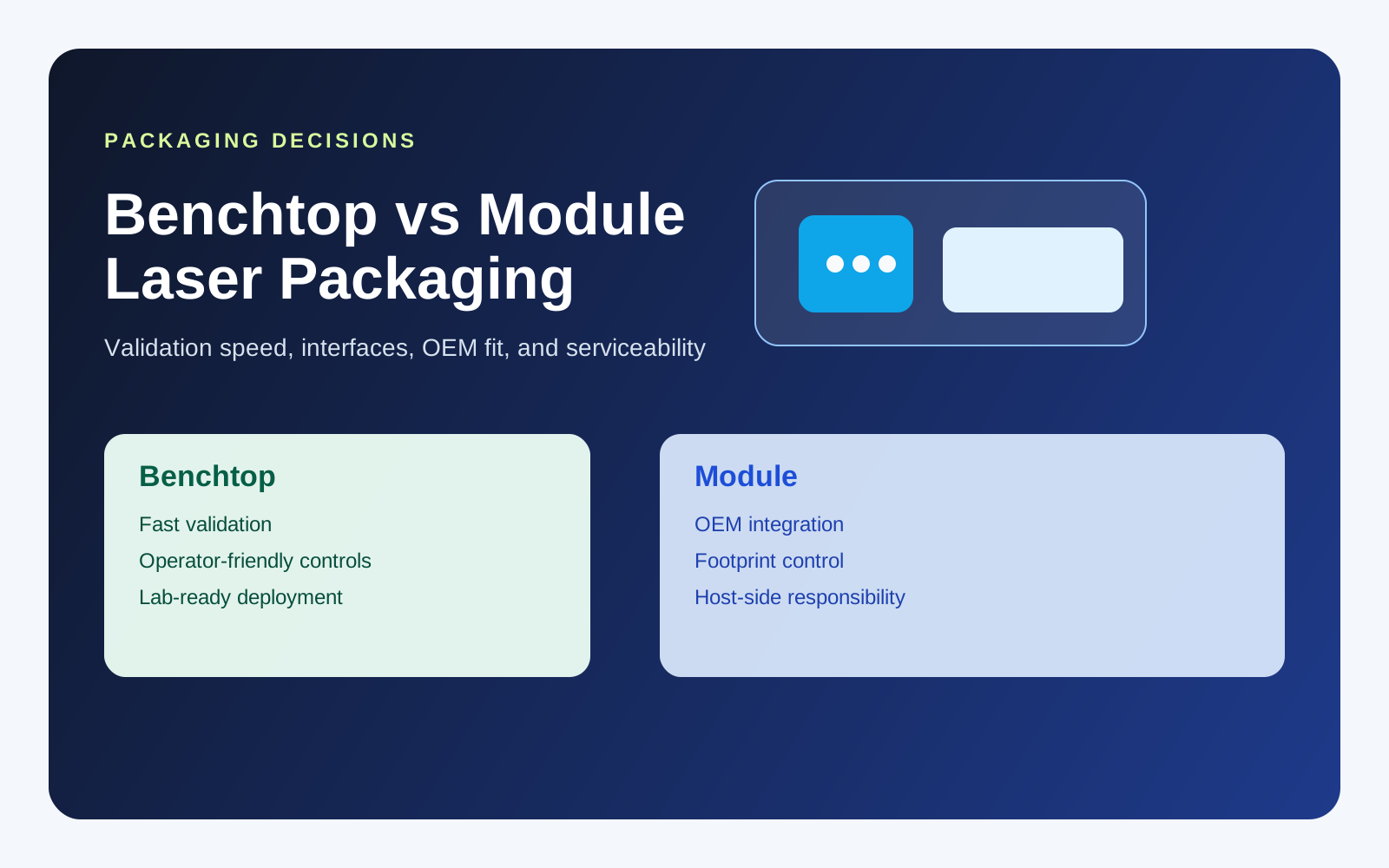
Benchtop vs Module Laser Packaging: What Engineering Teams Should Decide Early
A concise decision guide for choosing between benchtop and module formats based on validation speed, interfaces, serviceability, and OEM readiness.
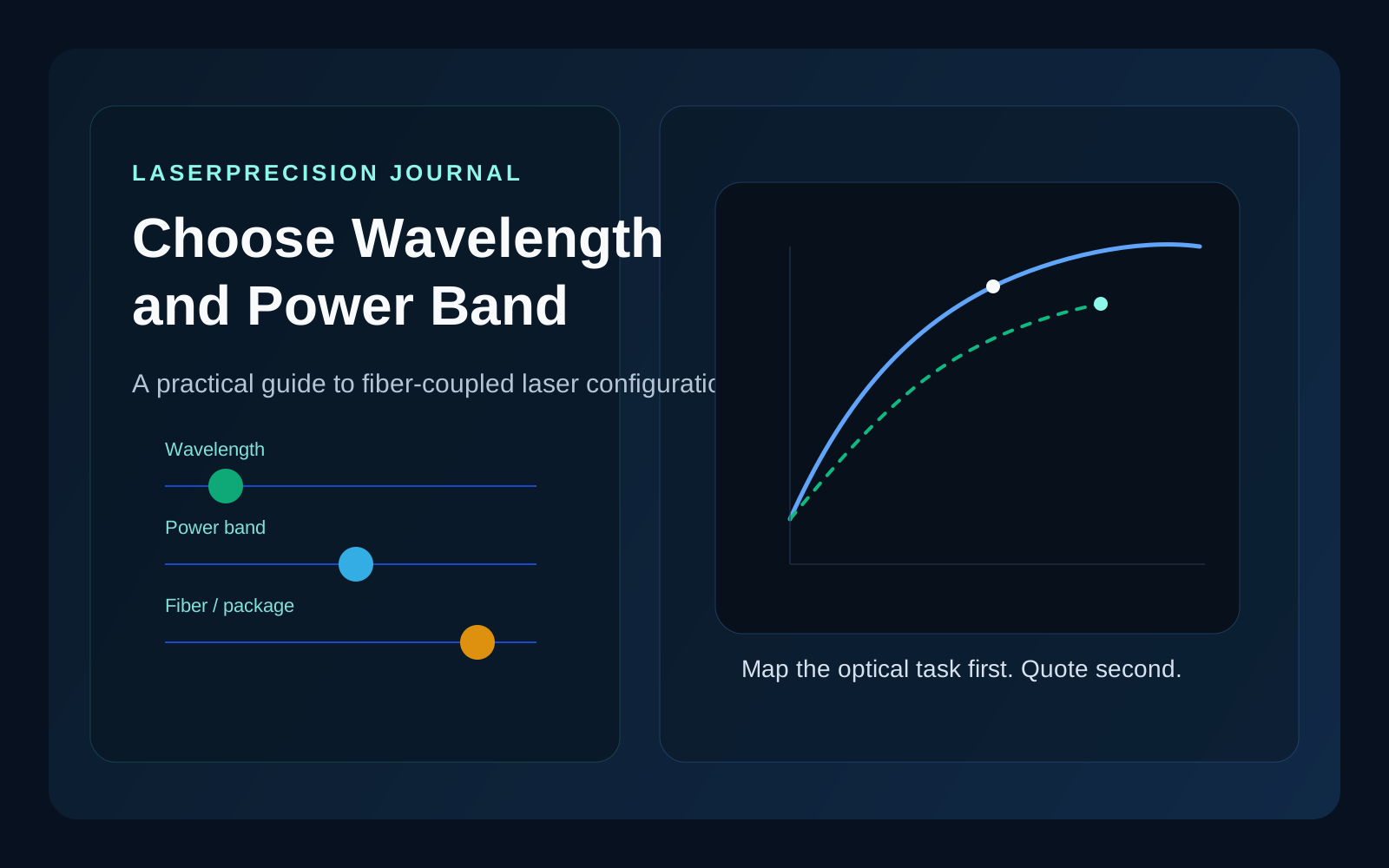
How to Choose the Right Wavelength and Power Band for a Fiber-Coupled Laser
A practical framework for narrowing wavelength, power, polarization, and package decisions before requesting a laser quotation.